
Tuesday, July 12, 2011


Friday, July 8, 2011
Climate
There is great variety in the climate, largely determined by altitude. It is mild year-round in the mountain valleys; Humid Subtropical Climate incoastal and Rain Forests in lowlands. The Pacific coastal area has a tropical climate, with a severe rainy season. The climate in the Andean highlands is temperate and relatively dry; and the Amazon basin on the eastern side of the mountains shares the climate of other rain forest zones.Because of its location at the equator, Ecuador experiences little variation in daylight hours during the course of a year. Both sunrise and sunset occur each day at the two six o'clock hours.
rerencehttp://en.wikipedia.org/wiki/Ecuador
rerencehttp://en.wikipedia.org/wiki/Ecuador
Thursday, July 7, 2011
Politics

Ecuador is governed by a democratically elected President, for a four year term. The current president of Ecuador, Rafael Correa, exercises his power from the presidential Palacio de Carondelet in Quito. The current constitution was written by the Ecuadorian Constituent Assembly elected in 2007, and was approved by referendum in 2008.The current President Rafael CorreaThe executive branch includes 25 ministries. Provincial governors and councilors (mayors, aldermen, and parish boards) are directly elected. The National Assembly of Ecuador meets throughout the year except for recesses in July and December. There are thirteen permanent committees. Justices of the National Court are appointed by the Council of Social Participation, for nine year terms.Ecuador has often placed great emphasis on multilateral approaches to international issues. Ecuador is a member of the United Nations (and most of its specialized agencies) and a member of many regional groups, including the Rio Group, the Latin American Economic System, the Latin American Energy Organization, the Latin American Integration Association, the Bolivarian Alliance for the Peoples of Our America, the Andean Community of Nations and the Union of South American Nations (UNASUR).
Military governments (1972–1979)
In 1972, a "revolutionary and nationalist" military junta overthrew the government of Velasco Ibarra. The coup d'état was led by General Guillermo Rodríguez and executed by navy commander Jorge Queirolo G. The new president exiled José María Velasco to Argentina. He remained in power until 1976, when he was removed by another military government. That military junta was led by Admiral Alfredo Poveda, who was declared chairman of the Supreme Council. The Supreme Council included two other members: General Guillermo Durán Arcentales and General Luis Leoro Franco. The civil society more and more insistently called for democratic elections. Colonel Richelieu Levoyer, Government Minister, proposed and implemented a Plan to return to the constitutional system through universal elections. This Plan enabled the new democratically elected president to assume the duties of the executive office.
referencehttp://en.wikipedia.org/wiki/Ecuador
referencehttp://en.wikipedia.org/wiki/Ecuador
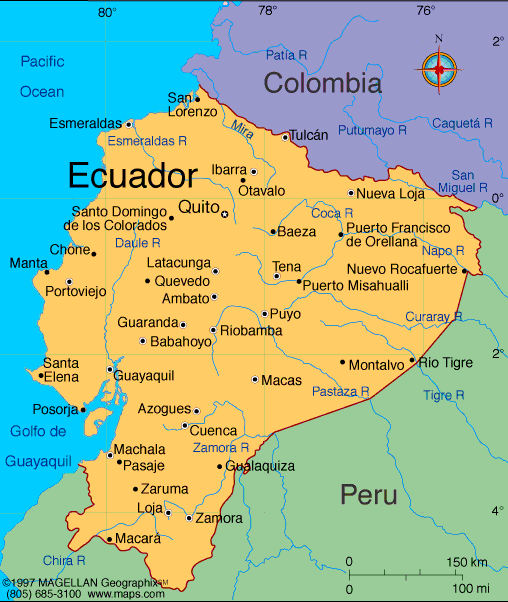
Ecuador
The tribes in the northern highlands of Ecuador formed the Kingdom of Quito around 1000. It was absorbed, by conquest and marriage, into the Inca Empire. Spanish conquistador Francisco Pizarro conquered the land in 1532, and throughout the 17th century a Spanish colony thrived by exploitation of the Indians. The first revolt against Spain occurred in 1809. In 1819, Ecuador joined Venezuela, Colombia, and Panama in a confederacy known as Greater Colombia.
When Greater Colombia collapsed in 1830, Ecuador became independent. Revolts and dictatorships followed; it had 48 presidents during the first 131 years of the republic. Conservatives ruled until the revolution of 1895 ushered in nearly a half century of Radical Liberal rule, during which the church was disestablished and freedom of worship, speech, and press was introduced. Although it was under military rule in the 1970s, the country did not experience the violence and repression characteristic of other Latin American military regimes. Its last 30 years of democracy, however, have been largely ineffectual because of a weak executive branch and a strong, fractious Congress.
Peru invaded Ecuador in 1941 and seized a large tract of Ecuadoran territory in the disputed Amazon region. In 1981 and 1995 war broke out again. In May 1999, Ecuador and Peru signed a treaty ending the nearly 60-year border dispute.Read more:Ecuador: History, Geography, Government, and Culture — Infoplease.comhttp://www.infoplease.com/ipa/A0107479.html#ixzz1RPu5yHdF
referencehttp://www.infoplease.com/ipa/A0107479.html
When Greater Colombia collapsed in 1830, Ecuador became independent. Revolts and dictatorships followed; it had 48 presidents during the first 131 years of the republic. Conservatives ruled until the revolution of 1895 ushered in nearly a half century of Radical Liberal rule, during which the church was disestablished and freedom of worship, speech, and press was introduced. Although it was under military rule in the 1970s, the country did not experience the violence and repression characteristic of other Latin American military regimes. Its last 30 years of democracy, however, have been largely ineffectual because of a weak executive branch and a strong, fractious Congress.
Peru invaded Ecuador in 1941 and seized a large tract of Ecuadoran territory in the disputed Amazon region. In 1981 and 1995 war broke out again. In May 1999, Ecuador and Peru signed a treaty ending the nearly 60-year border dispute.Read more:Ecuador: History, Geography, Government, and Culture — Infoplease.comhttp://www.infoplease.com/ipa/A0107479.html#ixzz1RPu5yHdF
referencehttp://www.infoplease.com/ipa/A0107479.html
Subscribe to:
Posts (Atom)